IPR for the GDP

Join Dan & Wayne in conversation with Dr Sunil Hirani

Interproximal reduction for GDPs

IPR for the GDP from Zigzogaloo Productions on Vimeo.

Dan and Wayne will discuss how managing inter proximal reduction (IPR) can deliver successful clear aligner treatments within your dental practice.

Delegates will gain an understanding of treatment planning and a step-by-step guide.

Dr Sunil Hirani will give delegates his perspective on IPR tips for success.

This webinar will make taking your first step into this treatment area less daunting and demystify this often intimidating process.

Join Dan and Wayne in conversation with Dr Sunil Hirani and understand how you can deliver successful clear aligner treatments and be better prepared to avoid some of the pitfalls associated with IPR.

Learning outcomes

  • The importance of treatment planning in achieving the desired results
  • A perspective on risk management
  • The types of instrumentation for successful IPR
  • A step-by-step guide to IPR
  • Tips for success.

Why Use Active Aligners?

Drawing on the results of thousands of clear aligner treatments, Active Aligners has established treatment planning protocols to enhance the likelihood of treatment success. An expert team of orthodontists and technicians help to establish parameters to aid you in your case selection. 

What this means for you is that if a case is deemed as too complex or unlikely to succeed, the treatment plan will come back as a rejection or be flagged as predicting a compromised result.

Our aim is to help clinicians achieve successful results. That’s why the company ethos is:

“For Dentists, By Dentists”

with a caring and conscientious know-how that is beyond compare.

We will support you directly, respond to your queries and even provide training in your practice.


Top Tips-Troubleshooting Clear Aligners

By Dr Dan Shaffer BDS RDT PGCertDentLaw

Where clear aligner treatment goes wrong and what to do about it: dental health, case selection, expectations, refinement, attachments, IPR, monitoring and retention. With the two minute case selection video.

Case Selection for Active Aligners

By Dr Dan Shaffer BDS RDT PGCertDentLaw

Case selection Choosing the right case is the single decision that predicts how a first aligner case goes, and how the second one goes. Everything we have written on it is here in one place. Updated 12 September 2026. Dr Dan Shaffer, Clinical Director. Two minutes on which cases to take on and which to…

Case Selection (1 of 3)

By Dr Dan Shaffer BDS RDT PGCertDentLaw

Updated 12 September 2026. It is essential to select the cases that are likely to work and bring satisfaction to our patients. We can only achieve this through identification and management of realistic patient expectations and abiding by accepted orthodontic principles. Is your patient’s aligner fatigue going to dictate the end point of your next…

Case Selection (2 of 3)

By Dr Dan Shaffer BDS RDT PGCertDentLaw

Updated 12 September 2026. It is essential to select the cases that are likely to work and bring satisfaction to our patients. We can only achieve this through identification and management of realistic patient expectations and abiding by accepted orthodontic principles. Is your patient’s aligner fatigue going to dictate the end point of your next…

Case Selection (3 of 3)

By Dr Dan Shaffer BDS RDT PGCertDentLaw

Updated 12 September 2026. If a case is too challenging for clear aligners, do you really want to manage the situation where your patient’s mounting dissatisfaction and continued frustration weighs heavily on your clinical conscience? Is your patient’s aligner fatigue going to dictate the end point of your next case? How do we begin to…

IPR (Interproximal reduction) – TIPS FOR SUCCESS

By Dr Dan Shaffer BDS RDT PGCertDentLaw

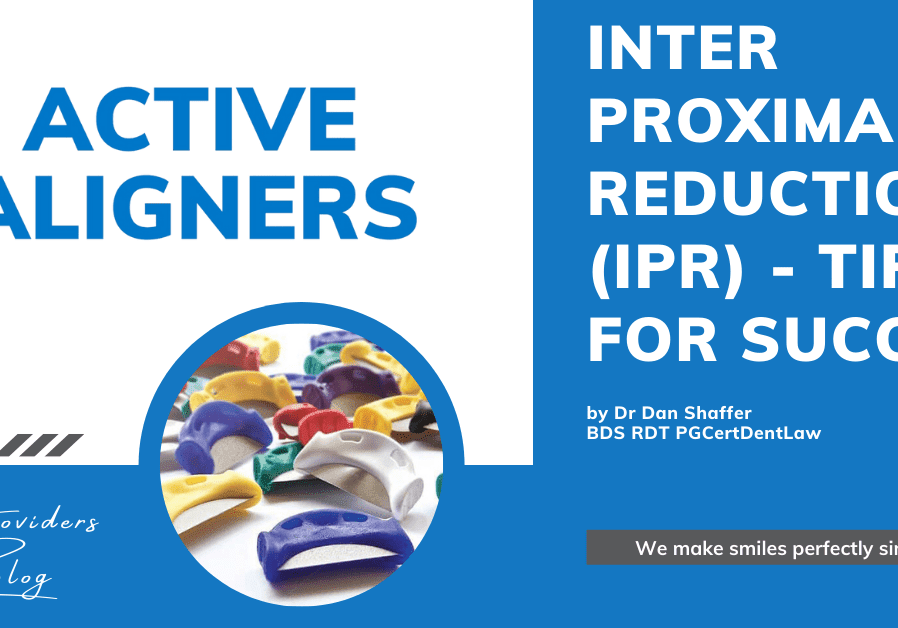
Updated 12 September 2026. Clear aligners work on basic orthodontic principles. They are used for the correction of crowded teeth, gaps or rotation, while achieving the desired results in an organised and planned fashion. These customised trays are “nearly invisible” and move the teeth in the desired direction.  This is achieved through wearing a series…

IPR made easy

By Dr Dan Shaffer BDS RDT PGCertDentLaw

Updated 12 September 2026. IPR Made Simple for the GDP: Risks, Benefits & Top Tips What is IPR and Why Does it Matter? Interproximal Reduction (IPR) is a common and often necessary technique in modern orthodontics, especially with clear aligners. For the general dental practitioner (GDP), understanding when, how, and why to use IPR –…

Composite Attachments made easy

By Dr Dan Shaffer BDS RDT PGCertDentLaw

Updated 12 September 2026. Composite Attachments Made Easy for the GDP composite attachments from Zigzogaloo Productions Why Composite Attachments Matter in Clear Aligner Success In clear aligner therapy, precision matters. While digital planning sets the stage, it’s the hands-on techniques like composite attachment placement that determine how well aligners perform in the mouth. For general…

How a Consistently Low Refinement Rate Enhances Outcomes with Active Aligners

By Dr Dan Shaffer BDS RDT PGCertDentLaw

How a Consistently Low Refinement Rate Enhances Outcomes with Active Aligners When evaluating clear aligner systems, refinement rates serve as a crucial metric that impacts both clinical efficiency and patient satisfaction. With Active Aligners achieving a consistently low refinement rate of approximately 23%-measured as a 12-month rolling average-dentists and patients experience significant benefits, both economically…

Interested in Active Aligners? Everything you need to know to get started.

By Dr Dan Shaffer BDS RDT PGCertDentLaw

Updated 12 September 2026. Interested in Active Aligners? Here’s a short article for potential providers of Active Aligners. Posted on 5th October 2021- 4 minute read With an intelligent workflow and simple portal, Active Aligners are designed to give you the skills and confidence to treat patients effectively. Clear aligner therapy is a modern alternative…