The Future of Dentistry is Tech-Driven
“Providing patients with cutting-edge dental treatment”
Posted on 20 October 2019
The current digital revolution is changing every aspect of our reality and dentistry is no different. Dentistry is advancing for the better of patient needs and you might be a little overwhelmed to see the tech-empowered options available for treating patients.
There is no doubt that our lives are becoming more technology driven as the years go by, and if you are in your mid 30’s or above, you’ve observed a great deal of technology and innovation, but these innovations won’t stop and will continue.
One technology that responsible for most of the credit for all the revolutions we seeing is the internet. The world-wide-web has changed the world, and continues to do so as it enables real time connectivity and communication, now newer technologies such as artificial intelligence, machine learning and a few others are helping to change the face of dentistry and oral-healthcare forever.
A benefit of advancements in dental technology is that it offers modern solutions to traditional problems, and the motivation behind the innovation is clear, it’s providing patients with leading-edge dental treatments that can be performed in a more efficient, affordable, effective and comfortable manner.
Dental Lasers
A high-tech option for detecting tooth decay and often eliminating the need for traditional dental tools like drills and scalpels. Not only are they more precise but often lower pain and sometimes remove the need for anaesthetic.
Benefits of laser are: reduction of bleeding, shorter healing times, sterilize the area as the professional works and requires removing less tooth surface when treating cavities or preparing teeth for cosmetic procedures.
Digital X-Rays
Digital X-rays are one of the basic services provided today to patients during a comprehensive exam. They eliminate the need for using conventional x-rays. Moreover, the use of technology means that you are exposed to less radiation and dental practices that use digital X-rays emit up to 90% less radiation than other practices.
Air Abrasion
A sound-free method of removing tooth decay and stains, air abrasion uses tiny particles of aluminium oxide or silica to gently wear away material. With the help of compressed air, the technology sprays the particles in the affected tooth. Patients stand to benefit the most from air abrasion as they will have lower dental anxiety which usually stems from the noise of the traditional drill.
Intraoral Cameras
Patients were constantly in a situation where they wondered what the dentist was doing in their mouth. Well, no need for them to wonder anymore as intraoral cameras show everything that’s happening. The cameras allow patients to view on screen what the dentist is doing inside their mouth. Additionally, a dentist can easily show patients their findings if they spot signs of tooth decay, gum disease, oral cancer lesions or other abnormalities. The technology is extremely useful in explaining dental services and terms to children.
CAD/CAM Technology
With the advent of the computer-aided-design (CAD) and computer-aided-manufacturing (CAM), the dental professional now:
- Saves time – Because CAD/CAM technology captures and displays a clients teeth and gums in a 3D image on a computer screen, It allows you to speed up the production of restorations between 2 to 5 days instead of 2 weeks that traditionally required.
- Saves money – Cost and value are always concerns when bringing new technology into a practice. CAD/CAM technology clearly boosts practice’s bottom line with more time available on the schedule, less chair time for patients, more production time for you, and great word-of-mouth marketing by satisfied patients. Many are also saving money because of lower lab fees as fewer impressions and temporaries are needed. In fact, calculating net profit and cost savings, most systems pay for themselves if by performing just a few CAD/CAM restorations or one and a half aligner cases per month.
- Predicts the final restoration – and how it will look on a patient. It allows patients to have a remarkable experience to decide the type of restoration that fits their desired look, all without the traditional impressions that require several processes.
- Improves the quality of restorations – It allows complete control over the process of design. Computer-aided design and computer-aided manufacturing allow design and creation of precise and accurate dental restorations.
- One potential downside is that not all offices have CAD/CAM technology, and there is a steep learning curve for some professionals
Clear Braces
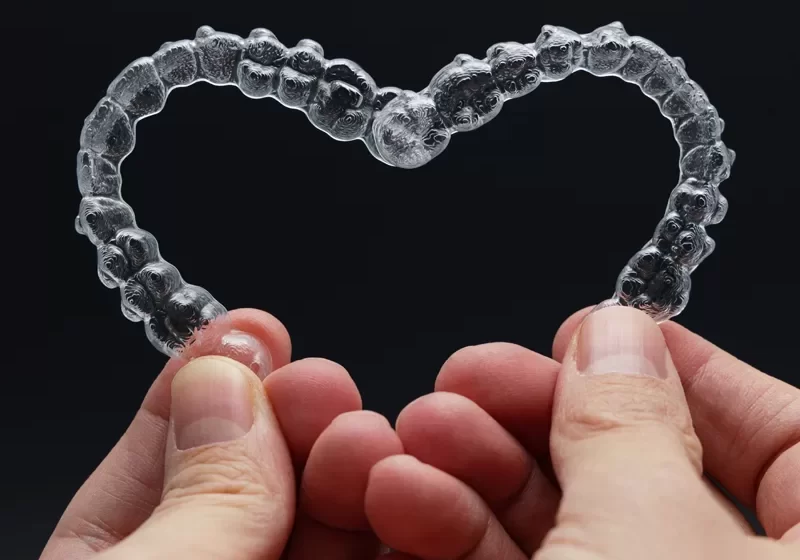
More and more dental practices are starting to offer patients clear aligners. A revolutionary option for straightening teeth, they are developed specifically for aligning teeth in a predictable, smooth, clear and comfortable manner. Aligners are changed every 1-2 weeks until teeth straighten. Just like metal braces, Aligners have proven to be effective.
Clear aligners work on basic orthodontic principles. They are used for the correction of crooked teeth, gaps or rotation, while achieving the desired results in an organized and planned fashion.
A little history on its Humble beginnings. In 1945 an American orthodontist by the name of Harold D Kesling invented a removable custom-designed appliance that looked and functioned similarly to a mouth guard. Made of rubber and worn on both teeth quadrants, the ‘tooth positioner’ as it was known, was really the first non-metal, removable device for straightening teeth. Used in conjunction with traditional braces, it sped up the process and is considered the frontrunner of what we know today as clear aligners.
Robotics in Dentistry
The not too distant future holds some really interesting potential breakthroughs for robotics in dentistry.
Here is an article and video – Robotics in Dentistry – that showcases many of the technologies listed above as well as shows how far dental professionals and robotics have come with technology.
In addition to the above, there are many more technologies changing the field of dentistry and oral healthcare. Coming soon, an in-depth look at 3D printing in dentistry.
John Burk
[jpshare]
John Burk

Director: Med-Bay